
Sandblasting has long been a default surface preparation method. Its limitations, however, are becoming harder to justify. Industrial laser cleaning is gaining consistent adoption across manufacturing and heavy industry.
Facilities demand cleaner results with fewer operational compromises. The factors below are ordered for procurement decisions. They help plant engineers and reliability leads evaluate where this technology delivers the most meaningful advantage.
What is Industrial Laser Cleaning?
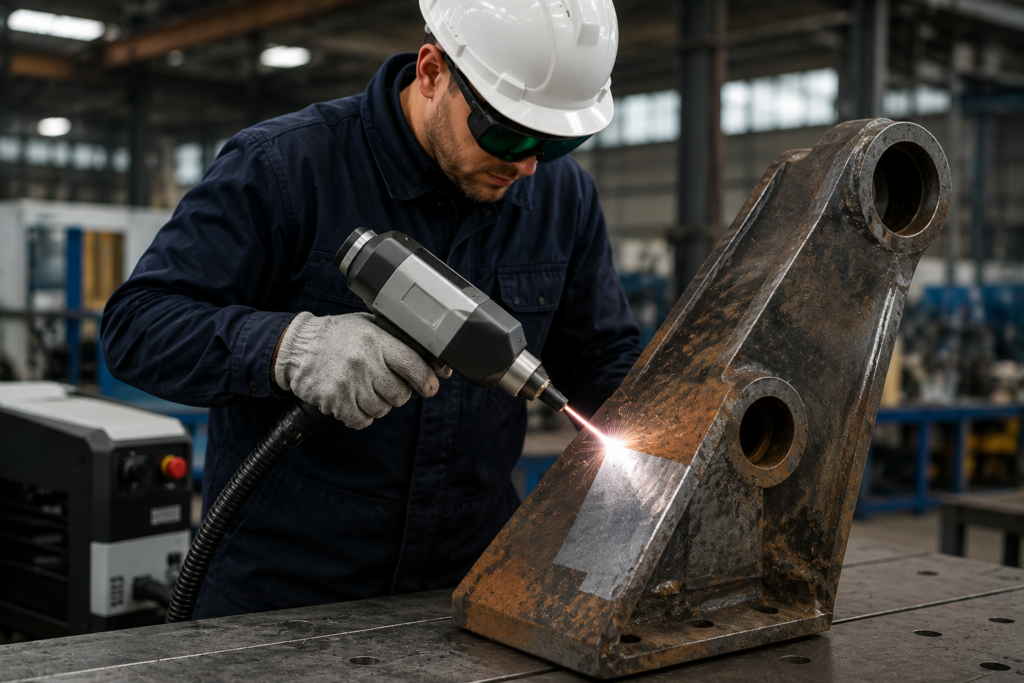
Abrasive blasting applies force indiscriminately. This creates risk on surfaces where dimensional tolerance matters. Industrial laser cleaning works differently. A focused beam vaporizes contaminants at the surface level. It transfers no mechanical stress to the substrate beneath. This non-contact mechanism separates it from pressure-dependent alternatives.
Facilities transitioning to this technology consistently report improved surface quality. Fewer post-process corrections are required. For operations that manage sensitive components or tight specifications, the shift away from abrasive methods is a quality-control decision. It is not simply a preference.
1. Precision and Substrate Preservation with Laser Cleaning Systems
Laser cleaning systems direct energy with control that sandblasting cannot replicate. The beam interacts only with the contaminant layer. The base material remains structurally intact. This matters most when working with hardened tooling or coated components. Sandblasting introduces micro-abrasion that accumulates over repeated cleaning cycles. Part integrity degrades gradually as a result. Laser systems eliminate that degradation pattern. For procurement teams managing component lifecycles, this distinction is operationally significant.
Key selection criteria for precision applications:
- Confirm the system offers adjustable pulse parameters for varying contamination depths
- Verify substrate compatibility testing has been completed for your material types
- Assess whether the system supports selective cleaning without masking adjacent areas
2. Environmental Benefits of Industrial Laser Cleaning Machines
Industrial laser cleaning machines require no abrasive media. They require no chemical solvents or consumable blasting compounds. This eliminates an entire category of procurement, storage, and disposal overhead. Sandblasting generates significant particulate waste. That waste requires containment and regulated disposal. Laser cleaning produces minimal secondary waste.
Vaporized contaminants are managed through a localized extraction system. For facilities operating under environmental compliance frameworks, this reduction in waste stream complexity is a material advantage. Sustainable manufacturing programs benefit directly from the reduced environmental footprint this technology delivers.
3. Operational Efficiency and Reduced Maintenance
Automated laser cleaning processes deliver consistent results across repeated production cycles. Operator-dependent variability is removed. Sandblasting outcomes shift with media condition, nozzle wear, and operator technique. Laser systems remove those variables entirely. Maintenance requirements for laser equipment are materially lower than for abrasive blast systems.
Abrasive systems involve regular media replenishment, nozzle replacement, and containment upkeep. Eliminating secondary cleanup steps meaningfully shortens the overall surface preparation timeline. For high-throughput environments, that time recovery compounds across production shifts.
Decision matrix:
- Best For: High-volume production lines, automated integration, regulated environments
- Not For: Applications requiring aggressive bulk material removal on a very large scale
- Cost Posture: Higher initial investment, lower ongoing operational cost
Why Industrial Laser Cleaning Is the Future
Industrial laser cleaning is a proven technology. Its adoption is widening across demanding industrial sectors. Companies evaluating advanced surface preparation solutions should assess this technology against their full operational cost picture. Waste disposal, maintenance cycles, and rework rates all factor into that picture.
Titan Laser Inc. provides specialized laser cleaning systems for industrial facilities. Application-specific training is also available to support a smooth transition. Rental and on-site laser cleaning services are available within Ontario. Contact today to identify the right system configuration for your surface types, contamination profiles, and throughput requirements.