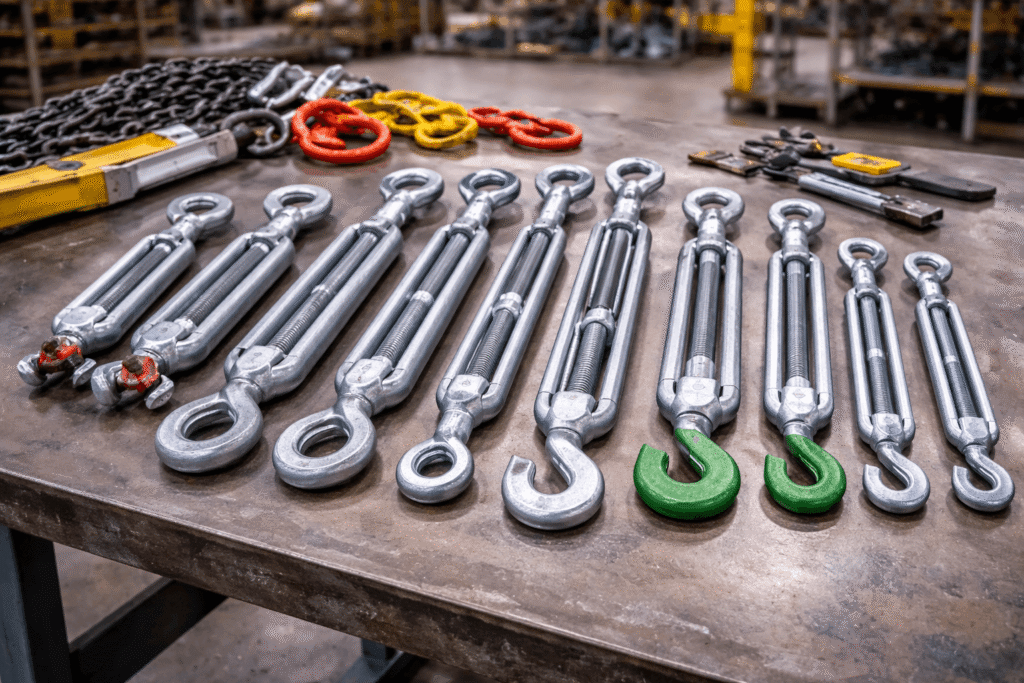

In heavy lifting and rigging systems, tension control is as critical as load capacity. Heavy-duty turnbuckles provide the fine adjustment needed to align loads, stabilize structures, and maintain consistent tension under varying conditions.
Relying on a single style limits flexibility and can introduce risk when connection requirements change. That’s why industrial teams often keep multiple turnbuckle configurations on hand to match different load paths, attachment points, and environments. This guide outlines five essential turnbuckle types and explains where each fits within a reliable lifting setup.
Why Turnbuckle Variety Matters
No two lifting scenarios are identical. Differences in anchor points, hardware orientation, and access constraints all affect which turnbuckle configuration performs best. Using the wrong end fitting can lead to uneven loading, complex installation, or unnecessary movement under tension. Maintaining a selection of industrial turnbuckles allows crews to adapt quickly while preserving system integrity and alignment.
Jaw & Jaw Turnbuckles
Jaw and jaw turnbuckles feature clevis-style ends secured with pins or bolts on both sides. This design creates a fully enclosed connection that resists accidental disengagement under load.
These turnbuckles are commonly used where:
- Connections must remain fixed once tensioned
- Load paths are predictable and aligned
- Safety requirements favor pinned connections
In structural bracing, tower supports, and permanent rigging systems, jaw and jaw models are often selected as a heavy-duty turnbuckle option because of their secure attachment and minimal movement once installed.
Jaw & Eye Turnbuckles
Jaw and eye turnbuckles combine a clevis end with a circular eye, offering a balance between security and flexibility of connection. The jaw end provides a pinned, non-detachable connection, while the eye end allows easy integration with shackles or hooks.
Typical applications include:
- Guy wire systems
- Temporary structural alignment
- Rigging assemblies with mixed connection hardware
This configuration is proper when one end of the system requires a fixed connection while the other benefits from rotational freedom during setup.
Eye & Eye Turnbuckles
Eye and eye turnbuckles feature circular eyes at both ends, making them among the most versatile options for lifting and tensioning setups. They allow quick connection to shackles, hooks, or threaded fittings without additional hardware changes.
They are often used for:
- General-purpose tensioning
- Adjustable bracing
- Applications requiring alignment flexibility
While not as rigid as jaw-ended options, eye and eye turnbuckles are widely used in systems where adaptability is more important than permanent fixation.
Stub End Turnbuckles
Stub-end turnbuckles feature threaded ends that integrate directly into structural members or custom assemblies. Instead of standard eyes or jaws, the threaded ends allow direct connection to tapped holes or welded fittings.
These turnbuckles are commonly found in:
- Custom-engineered lifting frames
- Fabricated equipment supports
- Permanent industrial installations
Because they are often specified for higher capacities, stub end designs are frequently selected as large, heavy-duty turnbuckles when space constraints or design requirements limit traditional end fittings.
Hook End Turnbuckles
Hook-end turnbuckles provide fast connection and disconnection, making them suitable for temporary or frequently adjusted setups. However, hooks do not offer the same level of security as pinned or eye connections and should be used carefully.
Appropriate uses include:
- Temporary bracing
- Light-duty alignment tasks
- Non-critical tensioning applications
In heavy lifting environments, hook ends are typically limited to controlled situations where load movement is minimal and constant supervision is possible.
Pair the Right Turnbuckle With the Right Load
Each turnbuckle type serves a distinct role within a lifting system. Jaw-ended designs prioritize security, eye-ended models offer flexibility, and stub ends support custom or high-capacity applications. By maintaining a range of industrial turnbuckles, crews can match the connection style to the load, environment, and required level of permanence.
Selecting the appropriate large turnbuckle for each task improves load stability, simplifies installation, and reduces unnecessary stress on rigging components. In heavy lifting setups, the proper turnbuckle configuration is not optional—it’s a key part of safe and efficient operation. For more information, contact us today!