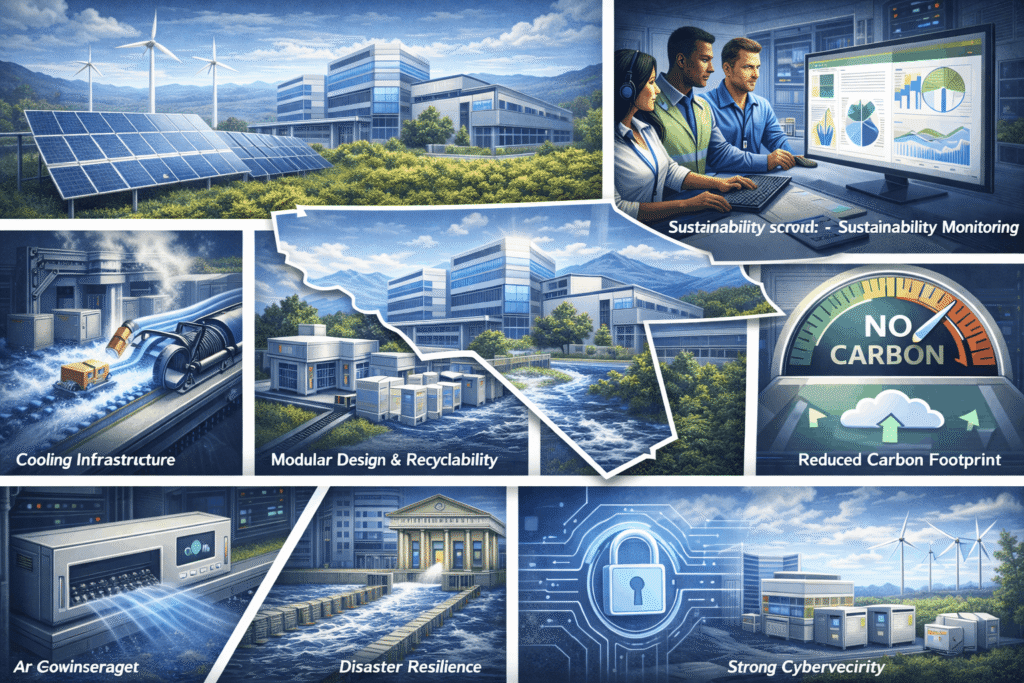

A modern data center in North Carolina is no longer defined by capacity alone. Power reliability, environmental responsibility, water use, and deployment speed now shape how digital infrastructure develops across the state. As AI workloads, enterprise platforms, and cloud demand grow, sustainability has shifted from an optional feature to an operating requirement.
North Carolina continues to attract data center investment due to favorable energy economics, strong fiber connectivity, and sustained business growth. The sustainability factors below define what separates legacy facilities from modern data center deployments in this market.
1. Renewable Energy Integration as a Core Power Source
Renewable energy plays a defining role in a data center in North Carolina deployment. Solar-powered infrastructure paired with battery storage reduces dependence on congested utility grids. This approach improves uptime while controlling long-term operating costs.
Facilities designed around renewable power operate with greater energy cost stability and reduced grid exposure. Consistent on site generation supports long-duration workloads such as AI training and enterprise processing during periods of grid congestion or regional outages.
2. Modular Architecture Supporting Faster Deployment
Modern data centers in Charlotte increasingly rely on modular architecture to reduce construction timelines and environmental impact.
Containerized data centers reduce construction timelines and limit environmental impact. These systems arrive pre-engineered and deploy rapidly on prepared sites.
Modular infrastructure minimizes land disturbance and material waste. It also allows capacity to scale incrementally, aligning energy use with actual demand rather than oversized initial builds. Shorter build cycles also reduce emissions associated with extended construction activity and material transport.
3. Distributed Siting Reducing Environmental Strain
A distributed siting strategy improves sustainability across data centers in Charlotte, North Carolina. Rather than concentrating compute in large hyperscale campuses, distributed facilities place capacity closer to users, energy resources, and network access points.
This design lowers transmission losses, reduces cooling demand, and improves latency. Smaller footprints also simplify permitting and reduce long-term land use impact across North Carolina communities.
4. Battery Storage Enabling Energy Resilience
Battery storage forms a core sustainability and resilience layer for a data center in North Carolina. Stored energy supports continuous operations during grid interruptions, peak demand events, and renewable generation variability.
Battery-backed infrastructure ensures training workloads, analytics, and enterprise systems remain operational. It also stabilizes renewable output, creating a reliable power environment for sensitive compute tasks.
5. Efficient Cooling Reducing Power Consumption
Cooling accounts for a significant portion of data center energy use. Modern Charlotte data centers apply optimized airflow design and high-efficiency cooling systems to lower overall consumption.
Lower cooling demand reduces electricity use while maintaining stable thermal conditions for sensitive equipment. This approach extends hardware life and lowers the overall environmental footprint of the facility.
6. Reduced Water Dependency in Facility Design
Water-efficient design has become a defining feature of responsible data centers in North Carolina. Modern facilities reduce reliance on water-intensive cooling systems, protecting local water resources while supporting long-term regulatory compliance as regional data center density increases.
7. Rapid Activation Supporting Sustainable Growth
Speed to operation directly affects sustainability outcomes. Facilities that activate quickly reduce prolonged construction emissions, temporary power use, and infrastructure strain compared to multi year build cycles.
Faster activation allows capacity to align with demand without overbuilding. This model supports responsible growth across North Carolina’s expanding digital economy.
Building Sustainable Digital Infrastructure in North Carolina
Sustainability defines how modern data centers operate across North Carolina and the Charlotte region. Renewable power, modular architecture, distributed siting, and energy resilience work together to create reliable, efficient infrastructure.
Flux Core Data Systems delivers this next generation data center model through modular, solar- and battery-powered distributed infrastructure. Systems reach full operation in as little as 90 days, supporting enterprises, AI developers, and cloud providers with secure, low latency, energy efficient compute.
Explore how Flux Core Data Systems supports modern data center deployments in North Carolina using renewable powered infrastructure designed for resilience, efficiency, and responsible growth.