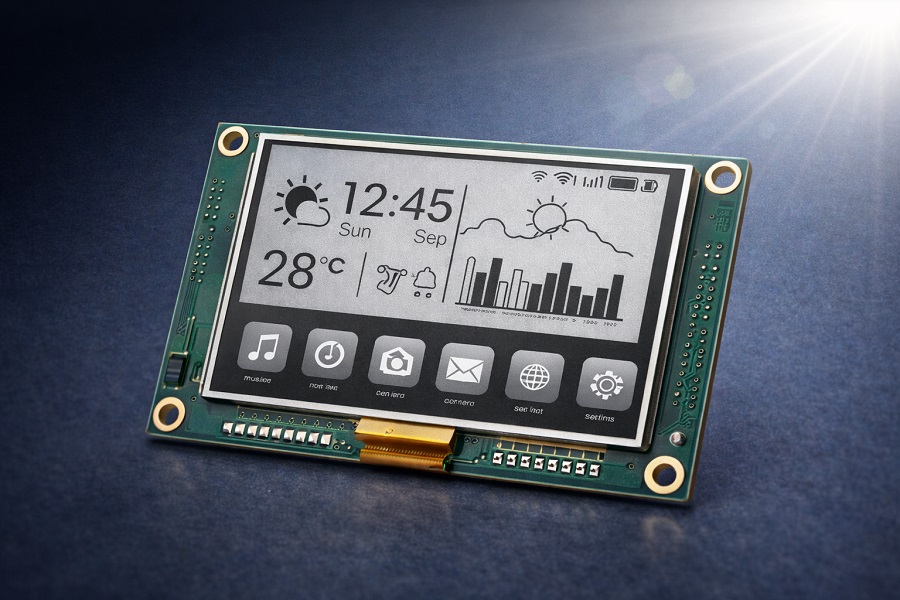

Displays used in sunlit or outdoor environments face a unique challenge. They must remain readable under intense ambient light while keeping power consumption low. Reflective LCDs address both requirements by operating without traditional backlighting.
Unlike transmissive LCDs, which rely on internal light sources, reflective LCDs use ambient light, such as sunlight, to illuminate on-screen content. This fundamental difference enables significant energy savings while improving visibility in bright conditions.
Below are the key ways reflective LCD technology reduces power use in sunlit environments.
1. Eliminating the Need for Backlighting
The most direct source of power savings comes from removing the backlight entirely.
Transmissive LCDs depend on constant backlight operation, even in bright outdoor settings where sunlight overwhelms screen brightness. Reflective LCDs function differently. A reflective layer behind the liquid crystal panel redirects ambient light back through the display, making images visible without internal illumination.
By eliminating backlighting, reflective displays avoid one of the most power-intensive components in conventional screens.
2. Using Ambient Light as the Primary Light Source
Reflective LCDs are designed to perform better as environmental light increases.
In sunlit environments, external light enhances display visibility rather than competing with it. This contrasts with transmissive displays, which must increase brightness to overcome glare, further increasing energy consumption.
Because reflective LCDs rely on ambient light, they consume minimal power regardless of outdoor brightness.
3. Reducing Heat Generation and Thermal Load
Backlights not only consume power but also generate heat.
Reflective LCDs operate with fewer active light-emitting components, resulting in significantly lower heat output. Reduced thermal buildup reduces the need for cooling systems, fans, or other heat-dissipation mechanisms, all of which add to overall power consumption.
Lower operating temperatures also support more stable performance in harsh outdoor environments.
4. Extending Battery Life in Portable Devices
Energy efficiency directly affects battery-powered equipment.
Reflective LCDs draw power primarily for image control rather than illumination. This allows devices to operate longer between charges, making them suitable for off-grid, solar-powered, or remote systems.
For field equipment that must remain active for extended periods, reduced display power usage can substantially increase operational runtime.
5. Minimizing Active Electronic Components
Reflective display architectures use fewer active elements than transmissive designs.
With no backlight drivers or continuously operating brightness control circuits, overall electrical demand decreases. Fewer components also reduce system complexity and potential failure points, improving reliability in rugged conditions.
This streamlined design supports efficient power management in embedded systems.
6. Improving Visibility Without Increasing Energy Demand
Bright environments typically force conventional displays to compensate by consuming more power.
Reflective LCDs maintain readability in direct sunlight without increasing energy input. As ambient light intensifies, visibility improves rather than degrades.
This characteristic allows consistent outdoor readability without dynamic power scaling or brightness adjustments.
7. Supporting Long-Term Operational Efficiency
Over time, reduced power draw contributes to longer system lifespan.
Displays without backlights avoid degradation associated with light-emitting components. Lower heat exposure further reduces stress on internal electronics, supporting stable long-term operation in outdoor and industrial settings.
These efficiencies help maintain performance consistency while keeping energy requirements low.
Everyday Use Cases in Sunlit and Outdoor Environments
Reflective LCDs are commonly used where visibility and energy efficiency must coexist, including:
- Outdoor monitoring and diagnostic equipment
- Handheld industrial and utility devices
- Field-based medical and inspection tools
- Agricultural systems and GPS-enabled equipment
- Transportation and infrastructure maintenance units
In these environments, reflective displays provide readable interfaces without increasing power demands.