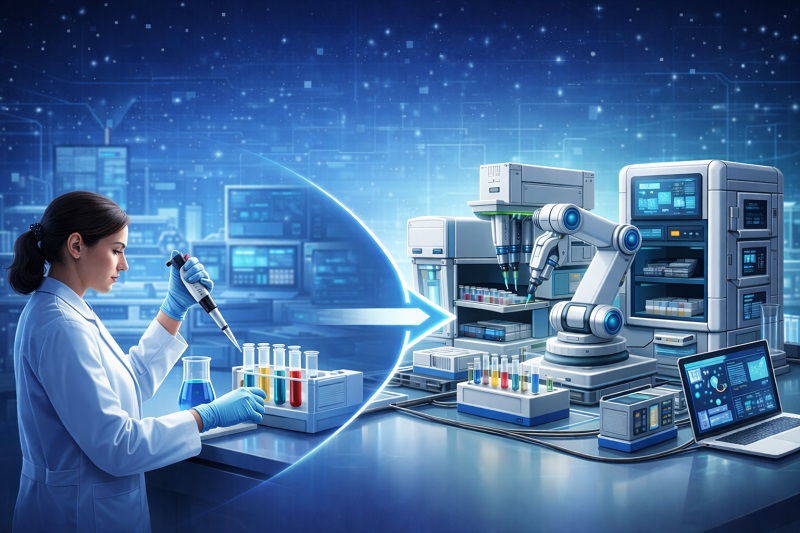

For decades, manual pipetting formed the backbone of laboratory workflows. In early-stage biotech research, it offered flexibility and direct control. However, as discovery pipelines expanded and throughput demands increased, the limitations of manual liquid handling became difficult to ignore.
Manual pipetting introduces variability, especially when experiments scale across hundreds or thousands of samples. Operator fatigue, inconsistent technique, and timing delays all impact reproducibility. These issues are magnified in assay development, compound screening, and cell-based workflows, where precision and repeatability are critical.
As biotech labs move toward higher throughput and more complex workflows, manual methods increasingly slow progress. This shift has driven widespread adoption of automated liquid handlers as a foundational tool in modern R&D environments.
Why Automated Liquid Handlers Are Now Modular
Early generations of automation were often rigid and monolithic. Labs had to commit to large, fixed systems designed for specific workflows. While powerful, these platforms were difficult to adapt as research priorities changed.
Today’s automated liquid handler is fundamentally different. Modern systems are modular by design, allowing labs to configure and expand capabilities incrementally. Instead of replacing entire platforms, teams can add pipetting heads, deck positions, plate formats, or integration components as needed.
This modularity supports:
- Gradual scaling from low- to high-throughput workflows
- Rapid reconfiguration for new assays
- Easier maintenance and upgrades
- Lower risk when expanding automation
We see modularity as essential for biotech labs that evolve continuously. Automation should adapt to science—not force science to adapt to hardware constraints.
Integration-Ready Automated Liquid Handling Systems
Another defining feature of modern automated liquid handling systems is integration readiness. Liquid handlers are no longer standalone devices; they operate as part of connected automation ecosystems.
Integration-ready systems are designed to communicate with:
- Scheduling and orchestration software
- Robotic arms and plate movers
- Incubators, readers, and washers
- LIMS and data management platforms
This connectivity allows liquid handling steps to align precisely with upstream and downstream processes. Instead of waiting for manual intervention, samples move seamlessly through workflows based on timing, availability, and dependencies.
We focus on integrating liquid handling platforms into coordinated workflows. By connecting liquid handlers directly to orchestration software, labs can automate not just pipetting—but entire experimental sequences from preparation to analysis.
Examples in Assay Development and Compound Management
The impact of modular liquid handling is especially clear in assay development. Early-stage assays often require frequent iteration. Conditions change, volumes shift, and protocols evolve. Modular automated liquid handling systems allow scientists to adapt workflows quickly without revalidating entire platforms.
In assay development, automation supports:
- Rapid optimization of protocols
- Consistent execution across replicates
- Smooth transition from development to screening
Compound management is another area where modular systems excel. As libraries grow, liquid handlers automate dilution, plating, and redistribution with precision. Integration with storage systems and scheduling software ensures compounds are delivered exactly when needed, reducing idle time and handling errors.
These use cases highlight a broader trend: automation is no longer about speed alone. It’s about maintaining consistency while supporting change.
What to Look for in a Future-Proof System
As modular liquid handling becomes the norm, selecting the right platform requires careful evaluation. A future-proof automated liquid handler should offer:
- Modular architecture
The ability to add capabilities without replacing core hardware. - Workflow flexibility
Support for multiple assay types, plate formats, and volumes. - Integration capability
Native compatibility with scheduling software, robotics, and data systems. - Scalability
Capacity to grow with throughput demands and expanding pipelines. - Usability
Intuitive software that reduces training overhead and error risk. - Vendor openness
Avoidance of lock-in that limits future automation choices.
Software companies help biotech teams evaluate liquid handling platforms not just for current workflows, but for where their automation strategy is headed. Modular systems provide the flexibility needed to scale without disruption.
The Shift From Tools to Automation Building Blocks
One of the most critical changes in liquid handling is conceptual. Labs no longer view these systems as isolated tools. Instead, they are treated as building blocks within larger automation architectures.
A modern automated liquid handling system may support dozens of workflows, interact with multiple robots, and operate under centralized orchestration. This approach allows labs to optimize utilization, reduce redundancy, and improve visibility across experiments.
By shifting from manual pipetting to modular automation, biotech facilities gain not just efficiency but also resilience. Workflows can adapt as science evolves, without requiring constant reinvestment.
Conclusion
The evolution from manual pipetting to modular liquid handling reflects a broader transformation in biotech automation. Today’s automated liquid handler is no longer a rigid, single-purpose machine. It is a configurable, integration-ready component of a connected laboratory ecosystem.
For biotech teams facing growing complexity, modular automated liquid handling systems offer a practical path forward—combining precision, scalability, and flexibility.
Software companies work with labs to design automation strategies that grow with their workflows. By helping teams choose liquid handling platforms that integrate cleanly and scale incrementally, we enable sustainable automation that supports both today’s experiments and tomorrow’s discovery goals.