
Industrial manufacturers rely on sheet metal fabrication and metal stamping to produce components that meet strict performance and durability standards. From electrical enclosures and machine housings to brackets and structural assemblies, selecting the right production method directly influences cost, lead time, and final product quality.
While both processes shape metal into functional parts, they differ significantly in tooling requirements, production flexibility, and scalability. Understanding how each method operates allows engineering and procurement teams to align manufacturing strategy with project volume, complexity, and budget constraints.
What Is Metal Stamping?
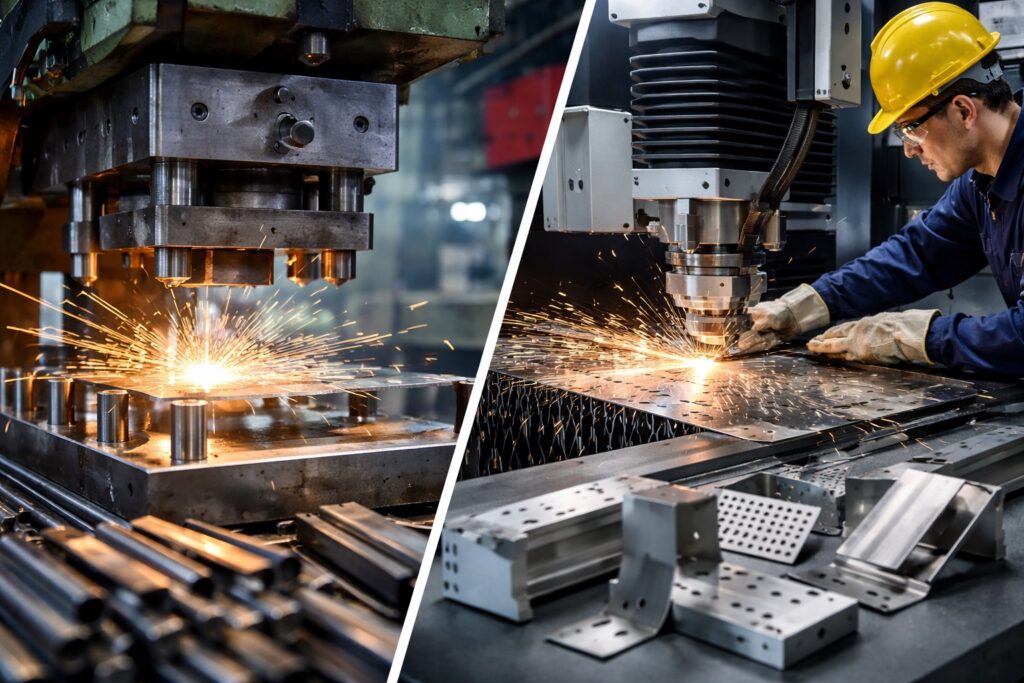
Metal stamping is a high-speed production process that uses dies and presses to cut or form sheet metal into predetermined shapes. The process typically involves custom tooling engineered specifically for a single-component design. Once the die is created and installed in a stamping press, it can produce identical parts at high volumes with consistent precision.
Stamping is commonly used for components that require simple geometries and repeatable features. Industries such as automotive and consumer goods often depend on stamping for brackets, clips, panels, and connectors produced in large quantities.
The main strength of stamping lies in its efficiency at scale. When production volumes justify the cost of tooling, stamping offers a low per-unit cost and rapid output rates. However, the upfront investment in dies can be significant, making the process less suitable for small production runs or evolving designs.
What Is Sheet Metal Fabrication?
Sheet metal fabrication is a broader manufacturing process that includes cutting, punching, bending, welding, and assembly. Instead of relying on a single dedicated die, fabrication uses programmable equipment such as CNC laser cutters, turret punch presses, and press brakes to produce components directly from digital design files.
This flexibility allows sheet metal fabricators to accommodate custom designs, prototype development, and low- to medium-volume production without incurring extensive tooling costs. Design modifications can be implemented quickly, supporting product iteration and project adjustments.
Fabrication is commonly used in industrial sectors requiring enclosures, frames, panels, and custom assemblies. The process supports a wide range of materials, including mild steel, stainless steel, and aluminum. Its adaptability makes it well-suited for projects that involve complex geometries, multi-step forming, or welded assemblies.
Key Differences That Impact Industrial Projects
Several operational differences influence the decision between stamping and fabrication.
First, tooling investment varies significantly. Stamping requires dedicated dies that are expensive to design and manufacture. Fabrication relies on flexible tooling and CNC programming, reducing initial capital requirements.
Second, production volume plays a critical role. Stamping becomes cost-effective when large quantities justify tooling expenses. Sheet metal fabrication remains economically viable for small- to medium-run orders that require customization or design flexibility.
Third, design adaptability differs between the two methods. Modifying a stamped part often requires reworking or replacing the die, which increases cost and lead time. Fabrication processes can accommodate design revisions through updated programming without major hardware changes.
Finally, part complexity and assembly needs may favor fabrication. Components requiring welding, multiple bends, or structural integration are often better suited to fabrication workflows.
When to Choose Stamping
Stamping is appropriate for high-volume production where part geometry remains consistent over time. Once tooling is established, production rates are high and per-unit costs decrease significantly.
Industries manufacturing standardized components benefit from stamping when demand is stable and predictable. The process delivers repeatable results for simple shapes that do not require frequent design changes.
However, careful evaluation of tooling investment and long-term production forecasts is essential before committing to stamping as the primary method.
When to Choose Sheet Metal Fabrication
Sheet metal fabrication is the preferred option for projects requiring flexibility, moderate volumes, or complex assemblies. Electrical enclosures, equipment housings, mounting frames, and structural components often demand precision cutting and multi-stage forming.
Sheet metal fabricators equipped with CNC machinery can efficiently manage prototypes, short production runs, and customized parts. This adaptability reduces risk during product development and supports evolving industrial requirements.
For manufacturers seeking responsive production without high upfront tooling costs, fabrication offers a practical, scalable solution.
Selecting the Right Manufacturing Approach
Choosing between stamping and fabrication depends on production volume, design stability, budget considerations, and component complexity. Stamping delivers efficiency for high-volume standardized parts, while fabrication offers flexibility and integration for customized industrial assemblies.
For organizations evaluating manufacturing strategies, Weldflow Metal Products provides comprehensive fabrication capabilities tailored to industrial applications.
Contact Weldflow Metal Products to discuss project requirements and determine how sheet metal fabrication services in Toronto can support reliable, cost-effective production outcomes.