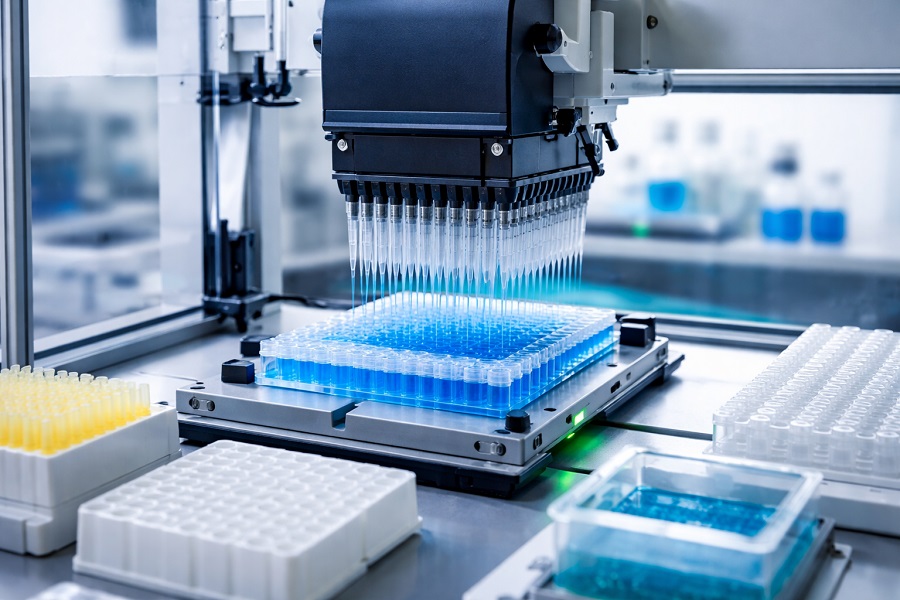

Biotech and life science labs are facing mounting pressure to deliver results faster while maintaining strict standards for accuracy and reproducibility. As screening volumes grow and workflows become more complex, manual pipetting increasingly limits both throughput and data quality. This has led many teams to reassess whether investing in an automated liquid handler still makes sense as labs plan for 2026 and beyond.
The question is no longer whether automation improves performance—it’s whether today’s automated liquid handling systems still deliver a strong return in an environment shaped by higher throughput demands, tighter timelines, and evolving automation ecosystems.
Benefits of Automated Liquid Handling
Automated liquid handling has long been a cornerstone of modern biotech R&D. Its value remains rooted in several core advantages that manual methods cannot match at scale.
First, precision and consistency are significantly improved. Automated systems dispense exact volumes across hundreds or thousands of samples with minimal variation, reducing errors caused by fatigue or technique differences. This consistency is critical for assays where even small deviations can impact results.
Second, throughput increases dramatically. Automated liquid handling systems process large batches in parallel, enabling labs to screen more compounds, run more replicates, and generate more data within the same timeframe. This directly supports faster discovery cycles.
Third, automation enhances safety and ergonomics. Reducing repetitive pipetting lowers the risk of strain injuries and limits direct exposure to hazardous reagents. Over time, this contributes to a healthier and more sustainable laboratory environment.
Finally, reproducibility improves. Standardized protocols executed by automation ensure that experiments can be repeated reliably—an essential requirement for drug discovery and validation workflows.
Evolving Expectations in 2026
While the core benefits remain strong, expectations around automated liquid handling have evolved. In 2026, labs no longer view these systems as standalone tools. Instead, they expect them to function as part of a broader automation ecosystem.
Modern labs prioritize flexibility. Automated liquid handling systems are expected to support a wide range of assays, plate formats, and workflows without extensive reconfiguration. Systems that are too rigid struggle to keep pace with rapidly changing research needs.
Integration has also become a key requirement. Labs expect liquid handlers to work seamlessly with scheduling software, robotic arms, incubators, and data systems. This integration reduces idle time and allows workflows to run continuously without manual coordination.
Additionally, ease of use matters more than ever. Interfaces that simplify protocol setup, error handling, and maintenance lower the barrier to adoption and reduce reliance on specialized operators. As automation becomes more widespread, usability directly impacts ROI.
Cost vs. Performance Comparison
From a cost perspective, automated liquid handling represents a significant upfront investment. Hardware, validation, training, and maintenance all contribute to the total cost of ownership. However, performance gains often offset these costs over time.
When evaluating value, labs should consider labor savings. Automation reduces the hours scientists spend on repetitive tasks, allowing them to focus on experimental design and analysis. Over multi-year timelines, these productivity gains can outweigh equipment costs.
Performance scalability is another factor. A well-chosen automated liquid handling system can support increased throughput without proportional increases in staffing or consumables. This scalability becomes especially important as programs move from early research into larger screening campaigns.
That said, not every lab needs the same level of automation. For low-volume or highly variable workflows, the cost-benefit equation may differ. In these cases, partial automation or modular upgrades may provide a better balance between performance and expense.
When It Makes Sense to Invest or Upgrade
Investing in or upgrading an automated liquid handler makes the most sense when:
- Sample volumes are increasing, and manual pipetting has become a bottleneck
- Reproducibility issues are impacting data quality
- Scientists spend excessive time on routine liquid handling tasks
- Integration with other automated systems is a strategic priority
- Existing equipment lacks flexibility or software compatibility
Conversely, labs should reassess investment timing if workflows are small-scale, highly exploratory, or unlikely to benefit from near-term standardized automation.
Conclusion
As biotech labs look toward 2026, automated liquid handling remains a valuable investment—but only when aligned with evolving workflow demands. Modern automated liquid handling systems deliver their greatest value when integrated into connected automation environments that prioritize flexibility, scalability, and usability.
For labs under pressure to increase throughput without compromising precision, investing in the correct automated liquid handler can still provide strong long-term returns. The key is choosing systems that support both today’s research goals and tomorrow’s growth.