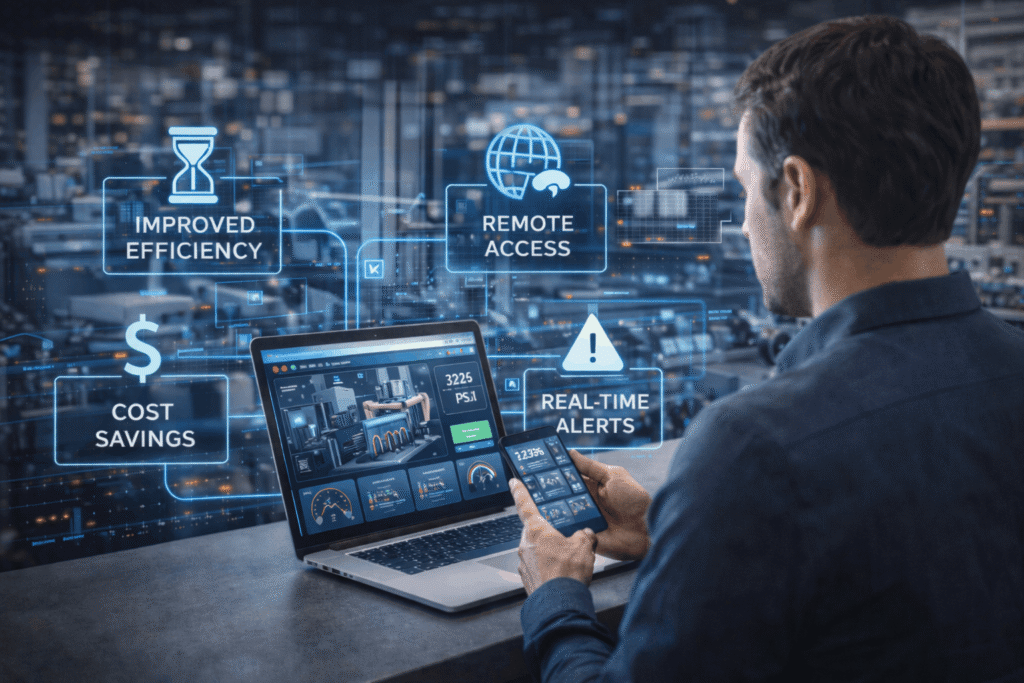

Critical infrastructure environments operate under constant pressure. Networks, facilities, and equipment must remain available at all times. Even brief disruptions can escalate into significant operational and financial losses. A Remote Monitoring System (RMS) provides organizations with continuous visibility and control, helping prevent failures before they disrupt operations.
For organizations managing distributed and high-risk environments, remote monitoring and control are no longer optional. It has become a foundational capability for performance, reliability, and long-term cost control.
Why Does Downtime Impact Productivity and Revenue So Significantly?
Downtime affects more than equipment availability. It disrupts workflows, service delivery, and contractual obligations. In sectors such as telecommunications, data centers, and utilities, even a few minutes of downtime can affect thousands of users.
Unplanned outages often result in:
- Lost service revenue
- SLA penalties and compliance risks
- Emergency repair costs
- Reputational damage
How Does Proactive Monitoring Support Managed Infrastructure Solutions?
Traditional monitoring models rely heavily on manual checks and delayed reporting. This approach creates blind spots across large or remote operations. Proactive monitoring transforms this model entirely.
With an integrated monitoring approach, operational data is continuously collected and analyzed. Industrial IoT solutions connect sensors, controllers, and gateways into a centralized platform. This allows teams to track performance trends rather than isolated data points.
Proactive monitoring enables:
- Early visibility into abnormal behavior
- Data-driven decision-making
- Reduced dependency on on-site inspections
How Does Early Fault Detection Improve Operational Response?
Failures rarely occur without warning. Most outages are preceded by subtle changes in performance, energy use, or environmental conditions. Without proper visibility, these indicators go unnoticed.
A modern Industrial IoT system detects these early signals and correlates them across assets and locations. Alerts are triggered based on thresholds, trends, or anomalies rather than on fixed schedules.
This improves response by:
- Allowing issues to be addressed before escalation
- Reducing mean time to repair
- Preventing cascading failures across systems
What Role Does Remote Monitoring Play in Improving Network Reliability at Scale?
Managing reliability across a single facility is challenging. Managing it across hundreds or thousands of distributed sites requires a different approach. Centralized visibility is essential.
A scalable Remote Monitoring System provides a unified view of all sites through a single interface. Performance metrics, alarms, and trends are standardized across locations. This consistency allows teams to compare sites and identify underperforming assets quickly and efficiently.
At scale, remote monitoring supports:
- Consistent operational standards
- Faster issue identification across regions
- Reduced operational complexity
How Do Remote Monitoring Solutions Reduce the Frequency of Outages?
Reactive maintenance often addresses symptoms rather than root causes. Over time, this increases outage frequency and operational instability. Remote Monitoring Solutions shift the maintenance model toward prevention.
Continuous monitoring allows teams to observe long-term trends in energy consumption, temperature, load behavior, and equipment health. These insights highlight inefficiencies and risks that would otherwise remain hidden.
Key benefits include:
- Fewer unexpected failures
- Improved asset utilization
- Better alignment between maintenance and actual conditions
What Are the Business Benefits of Reduced Downtime?
Operational reliability directly influences financial performance. Reduced downtime leads to measurable improvements across cost, revenue, and asset value.
Organizations using a remote monitoring system often see:
- Lower operating expenses
- Improved SLA compliance
- Higher infrastructure availability
- More predictable budgeting
How Do Industrial IoT Solutions Support Smarter Infrastructure Decisions?
Data alone does not create value. Value comes from turning data into insight and action. Industrial IoT solutions provide the connectivity and integration layer that enables this transformation.
By integrating field devices with analytics platforms, organizations gain contextual intelligence. Performance data is no longer isolated. It is analyzed alongside environmental, operational, and historical information.
This approach supports:
- Smarter energy management decisions
- Optimized cooling and power usage
- Better planning for capacity and expansion
An integrated Industrial IoT system ensures that decisions are based on real conditions rather than assumptions.
What Capabilities Should Organizations Expect From a Modern Remote Monitoring System?
A modern monitoring platform combines hardware, software, and analytics into a single ecosystem. It must support both intelligent and non-intelligent assets while remaining scalable and flexible for future growth.
Core capabilities typically include:
- Real-time monitoring and alerts
- Secure data transmission and storage
- Trend analysis and reporting
- Remote control and automation
How Does Remote Monitoring Enable Predictive Maintenance?
Predictive maintenance relies on recognizing patterns that signal future failure. This is only possible with continuous real-time data collection and analysis.
Remote monitoring platforms analyze asset behavior over time. Changes in energy usage, temperature variance, or operating cycles reveal early warning signs. Maintenance can then be scheduled based on actual operating conditions rather than fixed intervals.
This reduces:
- Unnecessary maintenance activities
- Asset wear from reactive repairs
- Downtime caused by unexpected breakdowns
What Industries Benefit Most From Remote Monitoring and Control?
Remote monitoring delivers value across multiple critical sectors. Its impact is strongest where uptime, safety, and operational efficiency are essential.
Industries benefiting include:
- Telecommunications networks
- Data centers and edge facilities
- Utilities and renewable energy sites
- Cable landing stations
- Public safety and emergency networks
Why Is Remote Monitoring Central to Long-Term Infrastructure Performance?
Infrastructure complexity continues to increase. Manual oversight cannot scale at the same pace. Remote monitoring provides the visibility, intelligence and actionable insights required to manage modern systems effectively.
By combining monitoring, analytics, and control, organizations create a foundation for continuous improvement. Performance becomes measurable. Risks become visible. Decisions become data-driven.
A Remote Monitoring System is no longer just a tool. It is a strategic asset that supports long-term operational and financial objectives.
How Do Remote Monitoring And Control Solutions Enable Smarter Infrastructure Management?
Integrated remote monitoring and control capabilities are built for mission-critical infrastructure environments where reliability and efficiency are non-negotiable. These solutions focus on transforming operational data into measurable business and financial outcomes through centralized visibility and intelligent analytics.
By combining advanced analytics platforms, unified hardware–software monitoring systems, and energy-efficient ICT cooling strategies, organizations can reduce downtime, optimize energy usage, and extend asset life. Flexible as-a-service delivery models support scalability and predictable operating costs across distributed facilities. The result is improved infrastructure reliability, stronger operational performance, and sustained return on investment (ROI).