
Winter maintenance across Canada requires equipment that efficiently and consistently handles heavy snowfall. Interest in automated solutions has increased significantly, especially with innovations like the Yarbo robotic snow blower, a fully autonomous system designed to manage snow removal with minimal intervention. As technology advances, many property owners are evaluating how modern machines compare with long-established gas-powered models.
The rise of robotic systems signals a shift toward safer, cleaner, and more efficient winter operations. Traditional gas blowers remain widely used, but the introduction of a snow blower robot presents new opportunities for improved performance and convenience. This comparison highlights how the Yarbo snowblower stands against traditional gas units in key performance areas.
Overview: Yarbo Snowblower vs. Traditional Gas Models
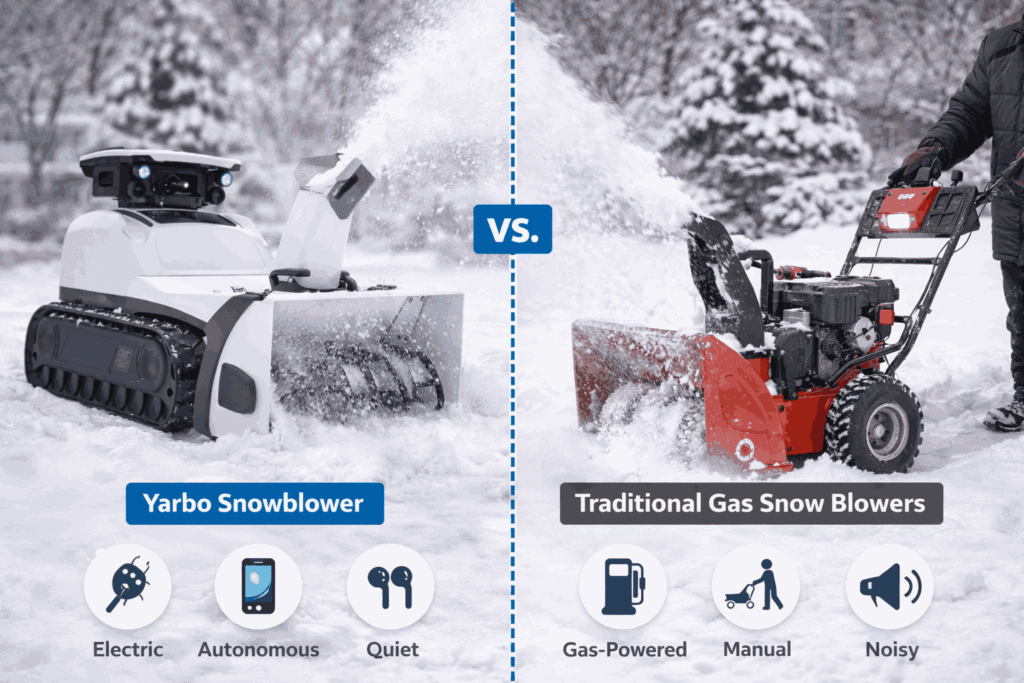
Traditional gas snow blowers rely on manual operation, combustion engines, and mechanical controls. The Yarbo system replaces manual handling with autonomous navigation, battery power, and integrated sensors, streamlining winter clearing tasks.
Ease of Use and Automation
An automatic snow blower like Yarbo removes the need for physical effort. Programmable routes, remote scheduling, and autonomous path correction simplify routine clearing. Gas-powered blowers require continuous handling, fuel loading, and manual steering.
Power and Performance in Heavy Snowfall
Gas blowers provide strong performance for dense or deep snow. Modern robotic systems now match this power through advanced brushless motors and precision auger designs. The Yarbo unit maintains consistent clearing across wide driveways, walkways, and textured surfaces.
Maintenance and Upkeep
Gas models demand ongoing servicing, including spark plug checks, oil changes, carburettor cleaning, and fuel stabilization. A battery-powered snow blower robot requires significantly less mechanical upkeep, with fewer moving parts and no fuel-related wear.
Environmental Impact
Electric power eliminates emissions, fuel storage, and exhaust fumes. This provides a cleaner approach to winter maintenance, supporting environmentally conscious property management.
Safety and Navigation Technology
The Yarbo platform integrates sensors, obstacle detection, LiDAR navigation, and anti-slip traction controls. These technologies help the machine operate safely around vehicles, walkways, and uneven terrain. Gas blowers depend entirely on operator control to avoid hazards.
Cost and Long-Term Value
Gas blowers typically cost less at the outset but incur higher fuel, repair, and mechanical parts costs. An automatic snow blower requires a higher initial investment but lowers ongoing costs and delivers long-term operational efficiency.
Year-Round Utility: The Modular Advantage of Yarbo
A key distinction is Yarbo’s modular system. The core drive unit adapts to multiple attachments, supporting mowing, leaf clearing, and other outdoor tasks year-round. Traditional blowers remain limited to seasonal use.
User Experience and Smart Control
The Yarbo platform offers app connectivity, live monitoring, wireless adjustments, and programmable clearing patterns. This creates a more seamless and controlled experience suitable for residential, commercial, and institutional spaces.
The Verdict: Is the Yarbo Snowblower Worth the Switch?
The combination of automation, reduced maintenance, smart navigation, and multi-season utility positions Yarbo as a valuable alternative to gas-powered models. Its design aligns with modern outdoor priorities, emphasizing efficiency and environmental responsibility.
Redefining Winter Maintenance in Canada
The shift toward automated snow clearing represents a meaningful evolution in winter property maintenance. Robotic snow blowers demonstrate growing potential as reliable, low-emission solutions for Canadian conditions, offering a modern approach to managing snow with less effort and greater consistency.