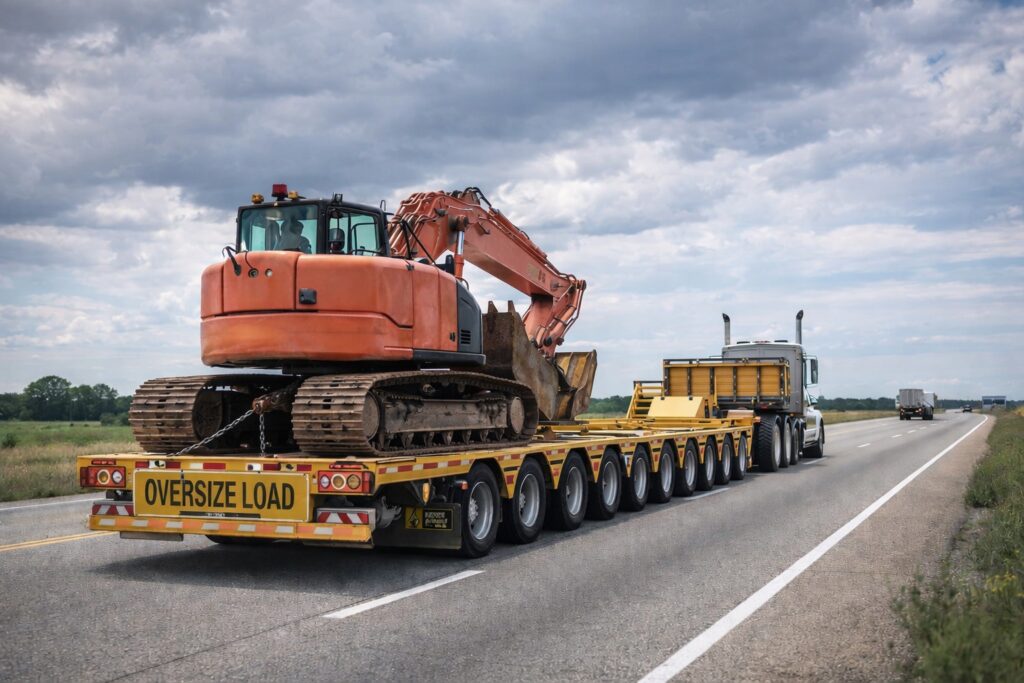

Some freight simply cannot move on a standard trailer. When cargo is too large, too heavy, or too complex for conventional equipment, multi-axle trailers become the only viable solution. These specialized configurations allow heavy haul trucking companies to move over-dimensional freight safely, legally, and on schedule.
Here’s how they make it possible.
The Right Tool for Oversized Freight
Weight limits govern every road in North America. Standard trailers concentrate cargo weight across fewer axles, which quickly pushes loads over legal thresholds. Multi-axle trailers solve this by spreading weight across more points of contact. This keeps individual axle loads within regulated limits and reduces stress on road surfaces — a factor that regulators in every jurisdiction take seriously.
1. Even Weight Distribution Across the Road
More axles mean less weight per axle. Oversized load trucking companies rely on this principle for every over-dimensional move. Without proper weight distribution, loads exceeding 80,000 pounds simply cannot travel legally. Axle configuration is calculated before permits are even filed, making this the starting point for every heavy haul shipment.
2. Improved Stability During Transit
More axles create a wider support base beneath the load. This reduces trailer flex on uneven surfaces and minimizes cargo movement during transit. For large industrial equipment or sensitive machinery, that stability prevents costly damage. It also improves driver handling on sharp curves, narrow roads, and long highway stretches.
3. Permit Compliance Across Every Jurisdiction
Permits are tied to axle weight limits in every state and province. Multi-axle trailers give logistics teams flexibility to meet those limits without reducing payload. Over-dimensional trucking companies invest in these configurations specifically because of their compliance value. Fewer violations mean fewer delays — and fewer delays mean lower total shipping costs for the shipper.
4. Multiple Configuration Options for Different Cargo Types
The right trailer depends on the cargo’s dimensions, weight, and loading method. Common multi-axle configurations used in heavy haul transport include:
- Removable gooseneck (RGN) trailers — allow equipment to be driven directly onto the deck
- Lowboy trailers — designed for extremely tall or high-clearance loads
- Extendable trailers — suited for long structural components like beams or pipes
- Double drop trailers — ideal for extra-tall cargo requiring a lower deck height
Heavy haul trucking companies select configurations based on the specific demands of each shipment.
5. Capacity to Handle Extreme Weight Loads
Some industrial shipments push far beyond standard limits. Large turbines, transformers, and prefabricated structures can exceed 100,000 pounds. Multi-axle trailers — some with 13 or more axles — are engineered for these extremes. Axle count is chosen based on total load weight and the weight restrictions of each jurisdiction along the planned route.
6. Protection of Road Infrastructure
Roads and bridges are rated for specific axle loads. Exceeding those ratings causes structural damage over time. Multi-axle trailers keep individual axle weights within safe limits, protecting public infrastructure on every run. Responsible oversize load trucking companies treat this as a core operating standard, not an afterthought.
7. Flexibility for Cross-Border Shipments
Cross-border routes add regulatory complexity. Each state and province enforces its own axle weight rules. Multi-axle trailers are adjustable, allowing logistics teams to modify axle spacing to meet varying requirements across jurisdictions. This flexibility is essential for long-distance, multi-jurisdiction freight moves between Canada and the United States.
Move Your Freight With MGA International
MGA International coordinates heavy haul freight across North America, managing permits, transportation partner selection, and end-to-end logistics. Services include cross-border LTL, FTL, flatbed, and eco-friendly intermodal transport. Contact MGA International today to get your next shipment moving.