
A pad eye can carry the correct rated capacity and a clean weld and still cause problems in the field: a shackle that does not seat, a sling pulling at an angle nobody accounted for, or a weld an inspector cannot reach. None of these issues appear on a spec sheet.
That gap, between an eye rated correctly and one that performs correctly in a specific rigging assembly, is where most selection errors start. The sections below cover where procurement and engineering teams most often run into trouble when specifying pad eyes, and what to confirm before ordering.
Not Every Pad Eye Is Rated for Lifting
“Pad eye” describes a shape, not a rating. The same name covers forged anchor points for tie-downs, marine deck fittings, and engineered lifting lugs, and these can sit side by side in the same catalog.
The Murphy Industrial Products, Inc. catalog shows the difference clearly. Its drop forged carbon steel pad eyes (part numbers 22005 through 22020) are marked “not suitable for lifting,” and its small T316 stainless pad eyes are listed without a working load limit. By contrast, its carbon steel pad eye lifting lugs list a WLL for every size, from 1/2 ton (LL0050) to 6.5 tons (LL0650), and each part carries a date code plus a weld specification and weld line marked on the lug.
If a part has no published WLL and no lifting instructions, treat it as a tie-down or anchor point, not a lifting point. Similar appearance is not a rating.
Where Load Geometry Changes the Math
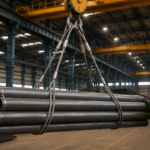
A published rating usually assumes an in-line pull in the plane of the eye. Once a sling approaches at an angle, from a two-leg bridle, a choker, or an offset attachment point, the force on the eye rises even though the load has not gotten any heavier.
The increase is larger than many teams expect. At a 60° sling angle, each leg carries about 1.15 times its share of the vertical load; at 30°, it carries twice that share. A team that sizes each eye by dividing total weight by the number of lifting points can under-specify capacity without noticing until the load is rigged. For the full method, an angle-factor table, and a worked example, see our guide to calculating the load on a pad eye or lug at different sling angles.
Weld-On or Bolt-On: Let the Structure Decide
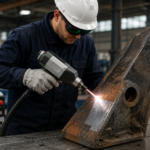
A weld-on pad eye suits a permanent attachment point where the base material supports a proper weld: adequate thickness, a weldable alloy, and access for a qualified welder. On structural steel, that weld is typically made to a procedure qualified under AWS D1.1, Structural Welding Code—Steel, or whatever code the project specifies. Problems start when a weld-on eye is specified for thin sheet, a casting not suited to welding, or a location where the correct procedure cannot be carried out on site.
Placement is also a one-time decision. Murphy Industrial Products, Inc. lists its carbon steel and stainless pad eye lifting lugs as single-use, one-time placement parts, so an eye cut off to make room for a modification is replaced, not re-welded elsewhere.
Bolt-on lifting points address a different need: equipment that is serviced, reconfigured, or disassembled on a regular cycle, or a mounting surface that cannot be welded. The trade-off is that the connection now depends on fastener grade, thread engagement, torque, and a mounting surface that can carry the load in bearing. Neither method is inherently better; the structure and the maintenance cycle should decide.
Stainless Changes the Corrosion Risk, Not the Inspection Schedule
A stainless steel pad eye earns its place around washdown cycles, chemical exposure, and marine environments, where carbon steel would need frequent maintenance to stay serviceable. The 316 stainless pad eye lifting lugs Murphy Industrial Products, Inc. offers (LLS0050 through LLS0650) match the carbon steel series size for size in listed WLL and dimensions, so moving to stainless does not force a change in shackle size.
It does change the weld. Joining a 316 eye to a carbon steel structure is a dissimilar-metal joint, and the filler metal and procedure need to be selected for that combination rather than carried over from a carbon steel weld.
Stainless also does not reduce inspection frequency. The criteria that matter, including deformation, cracking, wear at the pin contact area, and changes around the weld, apply regardless of material. The conditions that drive corrosion concerns often accelerate wear elsewhere in the assembly.
The Failure Point Is Often the Pin Fit
Lifting pad eyes are sized around a specific shackle. In the carbon steel series above, LL0200 is matched to a 1/2 in. shackle and LL0475 to a 3/4 in. shackle, and the holes are reamed to fit the shackle pin within ±0.01 in. That tolerance exists for a reason.
Engineers checking the eye of a lug commonly apply the pin-connected plate methods in ASME BTH-1, Design of Below-the-Hook Lifting Devices, which evaluate tension across the eye, tear-out beyond the hole, and bearing at the pin. Those checks assume a specific pin size. A pin much smaller than the hole concentrates bearing on a narrow band, while an oversized shackle bow can crowd the eye so the load bears on the plate edge and adds bending the eye was not designed for.
The same logic applies to a pad eye hook connection: hooking directly into an eye only works when the plate fits the hook throat and seats in the saddle, not on the tip. Confirm pin diameter, jaw width, and throat opening against the eye’s dimensions, not only its rating, when selecting lifting shackles or hooks.
Inspection Access Should Be Designed In, Not Retrofitted
Weld-on pad eyes need enough clearance for personnel to examine the weld, the eye body, and the surrounding structure. That requirement is easy to miss at the specification stage, when the goal is a convenient mounting spot, and hard to fix later, once piping, conduit, or guarding has to be removed for every inspection.
A location that is easy to weld but requires disassembling adjacent equipment to inspect will be inspected less often than it should be. That is rarely negligence; the access problem simply makes routine inspection more burdensome than it needs to be.
Standardize by Equipment Class, Not Across a Facility
Standardizing on one lifting eye simplifies purchasing, spares, and training when a facility runs several machines with similar weights and mounting conditions. The mistake is applying one specification across dissimilar equipment purely for procurement convenience, leaving an eye oversized for light equipment and unsuitable for heavy equipment.
Group equipment by weight range and structural type first, then standardize within each group. That preserves the purchasing benefit without asking one part to cover loads and geometries it was never selected for.
Before Placing an Order
Most pad eye problems trace back to a mismatch between the part and its application rather than a defect in the part. Review the rigging plan, mounting structure, and connecting hardware together before requesting a quote. For unusual geometry, mixed materials, or a mounting surface outside standard configurations, contact Murphy Industrial Products, Inc. to review the specification before the order is placed.